
If you have a teenager heading off to campus in a few weeks, wisdom teeth removal before college may be the last thing on your to-do list — right behind dorm supplies and class registration. But for thousands of families across Greensboro, Asheboro, and the greater NC Triad, this narrow window between summer and fall semester is the single best opportunity of the year to get third molars taken care of.
At The Oral Surgery Institute of the Carolinas, our oral and maxillofacial surgeons — Dr. Christopher L. Durham, Dr. Michael McLennon, and Dr. Tibebu Tsegga — see a predictable surge in late-summer consultations for exactly this reason. Here’s why the timing matters, what the procedure actually involves, and how to plan recovery so your student starts the semester feeling like themselves.
Why Wisdom Teeth Need Attention in the First Place
Wisdom teeth, also called third molars, typically come in between the ages of 17 and 25. The human mouth is designed to hold 28 teeth comfortably. Wisdom teeth push that total to 32 — and for most people, there simply isn’t room.
Roughly 90 percent of people have at least one impacted wisdom tooth, meaning the tooth cannot fully break through the gum. An impacted third molar isn’t just a crowding issue. It can:
- Damage the healthy neighboring molar next to it
- Become infected, causing pain and swelling
- Trap bacteria that lead to gum disease in the back of the mouth
- Form a cyst around the base of the tooth, which can erode surrounding bone
This is why patients should generally be evaluated in the mid-teen years. Studies consistently show that early evaluation and treatment produce the best outcomes — younger patients have less-developed roots, denser healing capacity, and a lower complication rate than adults who wait until a problem forces the issue.
Why “Before College” Is the Strategic Window
Timing wisdom tooth extraction around the academic calendar isn’t just convenience. It’s genuinely better clinical planning.
Recovery happens at home, not in a dorm. The first 48 to 72 hours after surgery call for rest, ice packs, soft foods, and someone nearby to keep an eye on things. A parent’s kitchen beats a dorm room with a shared bathroom and a mini-fridge every single time.
No missed exams or clinical rotations. Most patients need two to three days of limited physical activity. Doing this in August means no scrambling to make up a midterm in October.
A responsible adult is required. If your student has IV sedation or general anesthesia, someone must drive them to the office, remain in the office during the procedure, and drive them home. They also cannot drive or operate machinery for 24 hours afterward. That’s much easier to arrange while everyone is still under one roof.
Problems don’t wait politely. An impacted tooth that flares up during finals week — three hours from home, with an unfamiliar dentist — is a far worse experience than a planned procedure with a surgeon your family already knows.
What Happens at the Consultation
Depending on the procedure, your consultation may occur the same day as surgery, or it may be scheduled as a separate visit. Either way, the initial consultation follows a clear path.
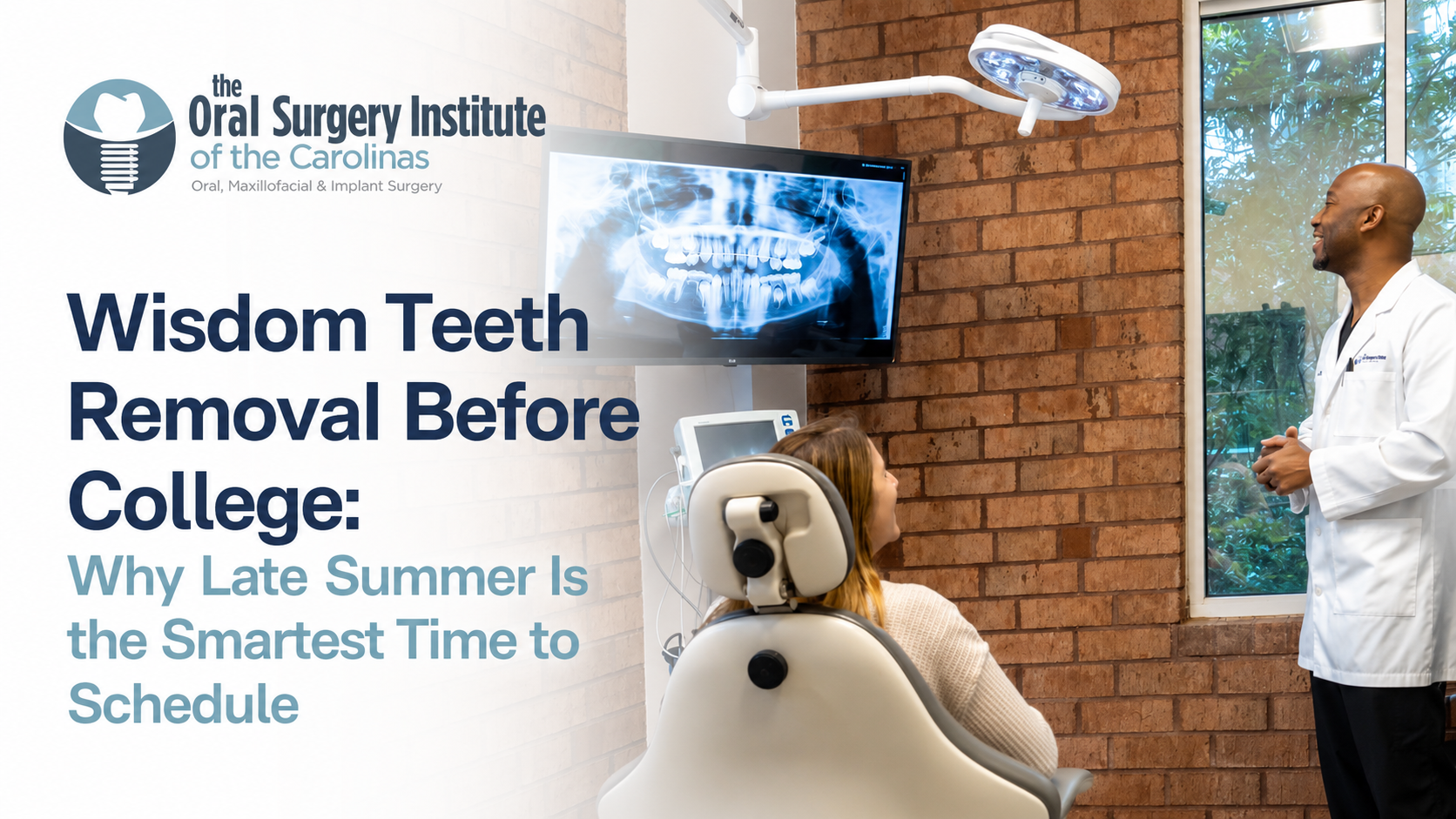
Your surgeon will take a panoramic X-ray to see the full picture of the teeth, roots, nerves, and surrounding structures. This imaging is often different from what your general dentist provides, and our digital imaging technology gives us a detailed view of exactly how each tooth is positioned before we ever begin.
From there, your surgeon reviews the X-rays and medical history with you, explains the findings, and builds a treatment plan together with you. You’ll also meet with one of our Treatment Coordinators to walk through insurance, payment options, and scheduling — so there are no financial surprises later.
If you’re currently under the care of a general dentist, a referral is ideal. It keeps everyone communicating about your care, and some insurance plans require proof of medical necessity that a referral can help satisfy. We also accept referrals from any treating provider rendering you dental care.
Anesthesia and Comfort: You Have Options
Anxiety about “being put under” is one of the most common reasons families delay wisdom teeth removal. It’s worth knowing that oral and maxillofacial surgeons complete extensive anesthesia training during residency, training alongside medical anesthesiology residents.
Our practice offers three anesthesia options:
- Local anesthesia — numbing the surgical area only
- Nitrous oxide — light relaxation with local anesthetic
- IV sedation / general anesthesia — the most common choice for impacted third molars
Your surgeon will recommend the most appropriate option for your specific case during the consultation.
We’re also serious about responsible pain management. Our practice actively works to combat the opioid epidemic by having surgeons complete annual opioid training, limiting prescribed narcotics, offering EXPAREL for non-opioid long-lasting post-surgical relief, and recommending over-the-counter options like Motrin and Tylenol where appropriate. For most wisdom teeth patients, ibuprofen manages discomfort effectively.
The Recovery Timeline, Day by Day
Here’s what a typical recovery looks like when post-operative instructions are followed carefully.
Day of surgery. Keep the gauze pad in place about 30 minutes, then discard it. Apply ice packs to both sides of the face continuously while awake — ice is most effective in the first 24 hours. Start pain medication as soon as the numbness begins to fade rather than waiting for pain to build. Rest, and skip physical activity entirely. Begin warm salt water rinses and gentle brushing that night.
Days 2–3. Swelling peaks here. This is normal and expected, not a sign something went wrong. After the first 24 hours ice no longer helps; around 36 hours, switch to moist heat on the sides of the face to help swelling resolve. Some patients notice black, blue, green, or yellow discoloration of the skin as blood spreads beneath the tissues — also normal. Jaw stiffness, called trismus, is common and resolves on its own.
Days 4–7. Discomfort should decrease noticeably each day. Around day four, begin using the curved-tip irrigation syringe with warm salt water to flush the lower extraction sites. Most students are back to class, work, or light routines by now. Sutures may loosen and fall out — simply remove and discard them.
Weeks 2–4. The socket gradually fills in with new tissue over the following month. Sore throats, mild temperature elevation, and small bony projections you can feel with your tongue are all common and typically resolve without intervention.
Call the office if pain or swelling worsens instead of improving, or if anything feels genuinely off.
Eating Well While You Heal
Nutrition matters more than most patients expect. Reduced food intake makes you weaker and slows healing, so aim for high-calorie, high-protein soft foods and at least five to six glasses of liquid daily.
Good choices include mashed potatoes, flaky fish like salmon, well-cooked pasta, oatmeal, grits, refried beans, pureed soups, applesauce, bananas, mashed avocado, yogurt, pudding, hummus, silken tofu, and ice cream. For more ideas, our post on soft foods and warm drinks for post-surgery recovery has full recipes.
Avoid hard, crunchy, or sharp foods like popcorn and nuts, alcohol, and hot foods or liquids while the mouth is still numb.
And absolutely no straws. Which brings us to the one complication worth taking seriously.
Dry Socket: The One Thing Worth Preventing
A dry socket occurs when the blood clot protecting the extraction site gets dislodged prematurely. It produces significant pain at the surgical site — sometimes radiating to the ear — typically two to seven days after surgery.
The three most common causes are entirely avoidable: smoking, drinking through a straw, and forceful spitting. Drink from a glass, let rinses passively flow out of your mouth into the sink rather than spitting, and avoid smoking for at least four to five days after surgery.
If you suspect a dry socket, call the office to schedule an appointment. It’s treatable, and quickly.
Insurance, Cost, and Scheduling in Greensboro and Asheboro
Many oral surgery procedures are covered by medical or dental insurance, though coverage depends on the specific procedure and your plan’s limitations. We accept most dental insurance plans and are currently in-network with Ameritas, BCBSNC, Delta Dental, and Guardian. We also accept Visa, MasterCard, American Express, CareCredit, and Lending Club for financing. Our team is happy to help you sort through the details — see our insurance and financial policies page or call us directly.
We serve patients from two convenient locations:
- Greensboro: 6 North Pointe Court, Greensboro, NC 27408 — (336) 275-6600
- Asheboro: 303 Ross St, Asheboro, NC 27203 — (336) 318-1014
Frequently Asked Questions
At what age should my child be evaluated for wisdom teeth? Patients should generally be evaluated in the mid-teen years, before roots are fully formed. Early evaluation and treatment have been shown to produce the best outcomes.
Does everyone need their wisdom teeth removed? No. Wisdom teeth that grow in completely without causing pain or crowding may not need extraction. However, about 90 percent of people have at least one impacted third molar. An X-ray and exam are the only way to know for certain.
How long does wisdom teeth removal take? Simple extractions can take just a few minutes. More complex impacted third molar surgery may take an hour or more, depending on tooth position and root development.
Is wisdom teeth removal painful? The procedure itself is performed under local or general anesthesia, so patients do not feel pain during surgery. Afterward, some discomfort and swelling are normal and are usually well managed with prescribed or over-the-counter medication.
How soon can my student return to school or sports? Most patients return to school or work within a few days. Strenuous activity and exercise should wait longer — reduced food intake after surgery can leave you weaker than usual, so stop if you feel lightheaded. Follow your surgeon’s specific guidance.
Schedule Your Consultation Before the Semester Starts
August fills quickly, and the pre-college window is short. If your student’s wisdom teeth haven’t been evaluated — or a general dentist has already flagged them — now is the time.
Call our Greensboro office at (336) 275-6600, our Asheboro office at (336) 318-1014, or book an appointment online.
Our mission is to provide a superior experience of quality oral surgery care — with a passion for compassion, understanding, and total satisfaction for our patients and referring doctors. Have more questions first? Visit our FAQ page.